
Cryptocurrencies all
Crypto market capitalization or “crypto market cap” for short is a widely used metric that is commonly used to compare the relative size of different cryptocurrencies. On CoinCodex, market cap is the default metric by which we rank cryptocurrencies on our frontpage free baccarat game. We also track the total cryptocurrency market cap by adding together the market cap of all the cryptocurrencies listed on CoinCodex. The total market cap provides an estimate on whether the cryptocurrency market as a whole is growing or declining.
Cryptocurrency works through networks of nodes that are constantly communicating with each other to stay updated about the current state of the ledger. With permissionless cryptocurrencies, a node can be operated by anyone, provided they have the necessary technical knowledge, computer hardware and bandwidth.
The miner that provides the correct solution to the problem first gets to add the new block of transactions to the blockchain and receives a reward in return for their work. Bitcoin miners are rewarded with BTC, Ethereum miners are rewarded with ETH, and so forth.
Do all cryptocurrencies use blockchain
Tokens can exist on several blockchains at the same time. Here’s how to move cryptocurrency from one network to another. Many cryptocurrency tokens simultaneously reside on more than one blockchain. Sometimes, users want to migrate assets between chains to perform a transaction available only on specific chains.
Blockchain is the innovative database technology that’s at the heart of nearly all cryptocurrencies. By distributing identical copies of a database across an entire network, blockchain makes it very difficult to hack or cheat the system.
Currently, data storage is centralized in large centers. But if the world transitions to blockchain for every industry and use, its exponentially growing size would require more advanced techniques to make storage more efficient, or force participants to continually upgrade their storage.
According to the definition of cryptocurrency, the answer is no. The defining characteristic of any cryptocurrency is that security is ensured with cryptography. Moreover, cryptocurrencies aren’t issued by a central authority, like a bank. In theory, this makes them immune to government interference or manipulation.
It can be used to record and track the ownership of a photographic image or a piece of music or a patent for a new gadget. It can even be used to track the provenance of food – from farm to plate – and medical supplies, including vaccines.
Once a block is closed, a transaction is complete. However, the block is not considered confirmed until five other blocks have been validated. Confirmation takes the network about one hour to complete because it averages just under 10 minutes per block (the first block with your transaction and five following blocks multiplied by 10 equals 60 minutes).
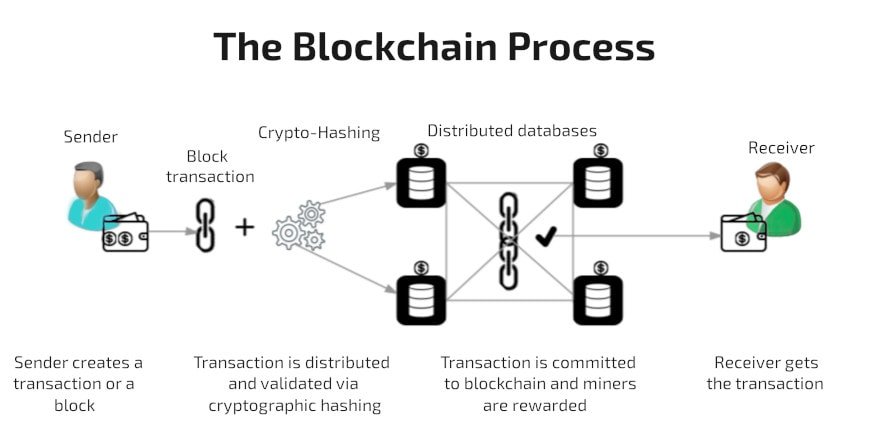
Are all cryptocurrencies based on blockchain
All information published on this website is provided in good faith and for general use only. We can not guarantee its completeness or reliability so please use caution. Any action you take based on the information found on cgaa.org is strictly at your discretion. CGAA will not be liable for any losses and/or damages incurred with the use of the information provided.
Perhaps no industry stands to benefit from integrating blockchain into its business operations more than personal banking. Financial institutions only operate during business hours, usually five days a week. That means if you try to deposit a check on Friday at 6 p.m., you will likely have to wait until Monday morning to see the money in your account.
Even if you make your deposit during business hours, the transaction can still take one to three days to verify due to the sheer volume of transactions that banks need to settle. Blockchain, on the other hand, never sleeps.
With many practical applications for the technology already being implemented and explored, blockchain is finally making a name for itself in no small part because of Bitcoin and cryptocurrency. As a buzzword on the tongue of every investor across the globe, blockchain stands to make business and government operations more accurate, efficient, secure, and cheap, with fewer intermediaries.
After the launch of IOTA, many non-blockchain protocols followed suit. However, most of them invented their own consensus algorithms to protect the network from double-spending attacks. Aside from IOTA, protocols utilizing DAGs also include Nano and Byteball.